 EN

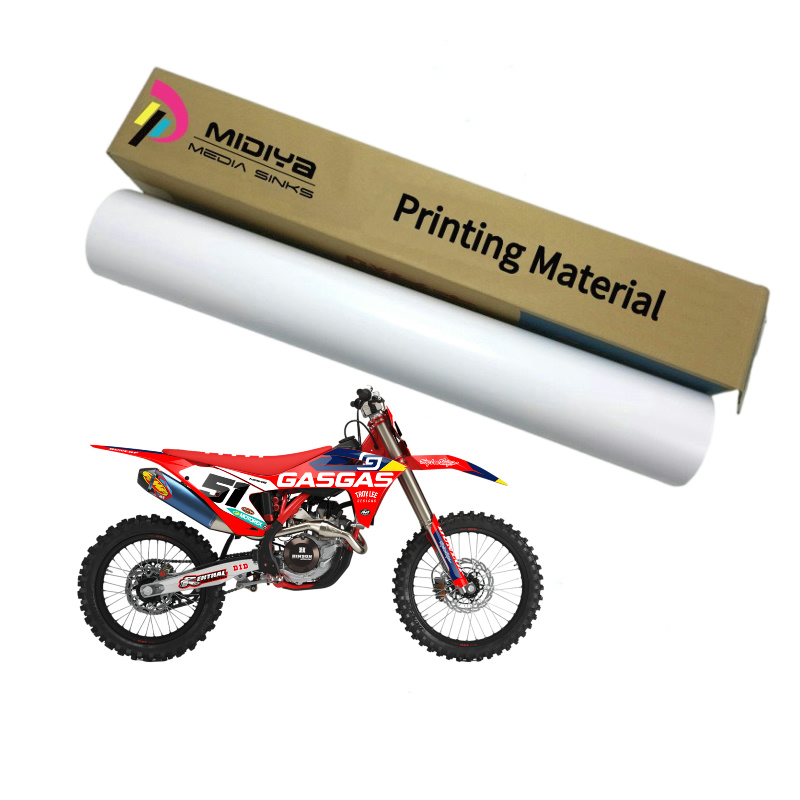
Polymeric vs Calendered Vinyl for Motorcycle Decals
Two words come up in almost every motorcycle decal enquiry: polymeric and calendered. Buyers use them as if they were opposite grades, and suppliers sometimes encourage that reading. In practice the words describe how a PVC film is made and how it is described on a spec sheet, not a guaranteed ranking of quality. This note explains what each term covers, what our own motorcycle film actually publishes, and what to ask for before you commit a roll to a curved fairing.
What the two words actually describe
Both terms are used across the vinyl industry to describe PVC film construction, and both appear in supplier catalogues as shorthand for how a film is expected to behave on a curved or riveted surface. The shorthand is convenient but imprecise: it says nothing about adhesive, liner, thickness or face film formulation, all of which change handling more than the construction label does.
The practical consequence is that a label alone cannot settle a purchasing decision. Two films both described as polymeric can behave differently on the same panel, and a film described as calendered is not automatically unsuitable for a motorcycle. The only reliable comparison is between published specifications and a physical sample on your own substrate, which is why we recommend testing before a production order rather than selecting by name.
What our polymeric motorcycle film publishes
Our motorcycle film is listed as a polymeric super high tack vehicle wrap film, supplied on a flat liner with air release channels. The published face film description covers resistance to shrinkage, good stretch, and resistance to cold and corrosion. The published adhesive description covers an ultra high tack adhesive that resists edge curl, roll back and delamination.
Intended use covers motorcycle decals, passenger car decals, yacht film and signage, plus surface colour change after digital printing. For printed work, the published recommendation is to apply a protective film over the print to extend service life.
Roll format is 1.27 m and 1.37 m wide at 50 m per roll. Standard lead time is 3 to 5 days for regular products and 7 to 10 days for customised orders, shipped from our Shanghai warehouse. Customisation can change film thickness, adhesive type and colour, liner grammage, roll dimensions, and brand logo printing on the liner or carton.
One point worth being explicit about: our published description does not state a film thickness figure or a formal cast versus calendered classification. If those two values matter to your job, ask for them on the current specification sheet rather than inferring them from the product name.
Why the liner matters more than the label on a motorcycle panel
Motorcycle work is dominated by compound curves, tight radii and recessed fasteners. On those surfaces the failure mode that costs the most is trapped air: a bubble that has to be pierced and reworked leaves a visible mark, and on a printed decal it usually means a remake.
That is why the air release liner deserves more attention than the construction label. Our film is supplied on a flat liner with air release channels, which gives trapped air a path to escape during squeegee work instead of being pushed toward the edge. Combined with a face film described as stretchable, this is what makes the film workable around a fairing rather than only on flat panels.
Two other published behaviours matter on a vehicle that flexes and sees weather: resistance to shrinkage, and resistance to cold. Both are described for this film. Neither is published as a service life figure, so treat them as directional claims and confirm against your own test panel.
Reading the tack name correctly
Our vehicle films are named in two parts: a tack level, then a removability class. The tack levels used across the range are super high tack, high tack and low tack, and the removability classes are removable and permanent.
The important caution is that these tack words do not carry published quantitative thresholds. No peel value and no shear figure is attached to them in our published data, so "super high tack" should not be read as a measured number and should not be compared to another supplier's "high tack" by name alone. Where a film is described as polymeric super high tack, the polymeric part describes the face film and the super high tack part describes the adhesive; they are two separate statements.
A short checklist for a sample request
Send four things with a sample request and the specification conversation becomes short: the substrate, the tightest radius you need to wrap, whether the graphic is printed and laminated, and the panel size you intend to cut from a roll.
Ask in return for film thickness, the construction classification, the adhesive description, liner type, and roll width and length availability. Test the sample on a scrap fairing or on the tightest curve in the job. If the film handles there without lifting at the edge or trapping air, the label question has answered itself.
If you are specifying decals for a motorcycle programme and want to compare our polymeric film against what you are using now, send the substrate and radius details and ask for a sample roll in 1.27 m or 1.37 m width to test on your own panel.